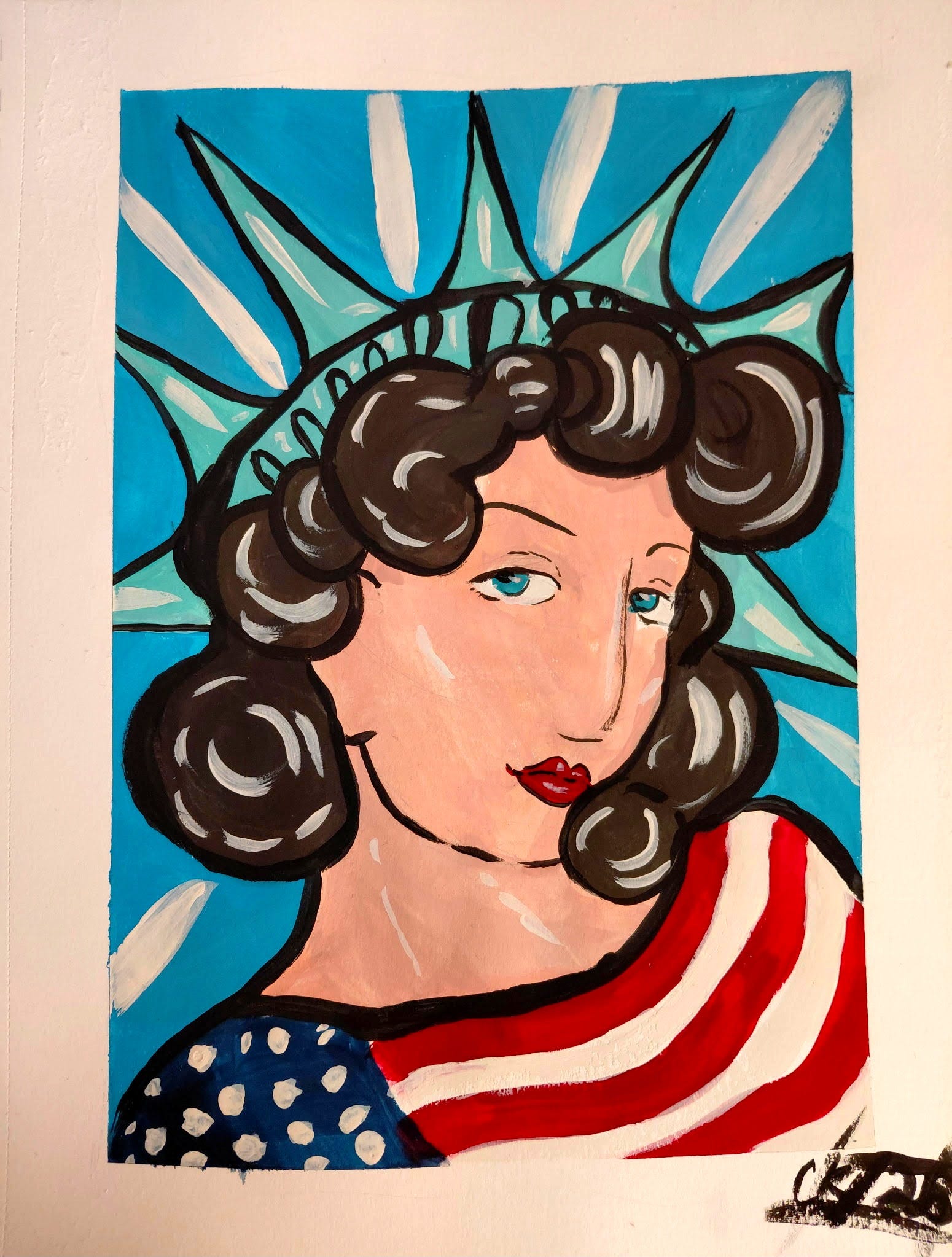


“Atom Bomb” is from the album Mighty Deeds, recorded Nov. 2021/Jan. 2022 at the Double Stop Fiddle Shop in Guthrie, Oklahoma.
“Why is it deemed incredible with you if God does raise the dead?”
- Acts 26:8
In January 1977 — the year I was born, a year in which fully one third of all American pregnancies ended in abortion — the State of Utah executed Gary Gilmore, a career criminal and convicted murderer, who gained worldwide fame in our nation’s bicentennial year for refusing to appeal his own death sentence, and insisting the state fulfill its obligation to put him before a firing squad.
Only recently paroled after spending much of his life incarcerated, in July 1976 Gilmore murdered two men in cold blood, shot both in the back of the head with a .22 pistol, execution-style, bloody, senseless acts that bore ironically, despite the idiom, little resemblance to the macabre pageantry whereby Gary himself met an end — strapped to an office chair in a converted prison cannery, hooded, with a small white circle pinned over his heart, shot by four anonymous riflemen in front of family and official witnesses, shot with steel-jacketed bullets to minimize the gore:
“When it happened, Gary never raised a finger. Didn’t quiver at all. His left hand never moved, and then, after he was shot, his head went forward, but the strap held his head up, and then the right hand slowly rose in the air and slowly went down as if to say ‘That did it, gentlemen.’ Schiller thought the movement was as delicate as the fingers of a pianist raising his hand before he puts it down on the keys. The blood started to flow through the black shirt and came out onto the white pants and started to drop on the floor between Gary’s legs, and the smell of gunpowder was everywhere. Then, the lights went down, and Schiller listened to the blood drip. He was not certain he could hear it drip, but he felt it, and with that blood, the life in Gilmore’s body seemed to lift off him like smoke.”
Gary Gilmore sought death not from a sense of justice or genuine remorse for his crimes, but instead out of sheer cussedness, the obduracy of an angry toddler, desperate for control, for a will to power. He hated the thought of a life behind bars, could no longer stand the light and the noise of his prison, craving above all silence — yet still having been unwilling or unable to adjust himself to the comparative repose and daily ambiguity of life on the outside. A firm believer in reincarnation, Gary preferred to take his chances elsewhere, seemingly untroubled by the karmic debt of two grieving widows with fatherless children, and so emblematic, despite having been locked away from Main Street USA for most of his life, of the wooly-headed bourgeois selfishness endemic to the 1970s, mired in its moral ennui, clue that though all lives might be worthwhile, some lives are simply wasted.
                                                    "I am one, my liege
Whom the vile blows and buffets of the world
Hath so incens’d that I am reckless what
I do to spite the world.”
Nearly a decade earlier, in October 1969, speaking before the members of the American Revolution Bicentennial Commission, charged with preparing for and coordinating the nation’s impending anniversary celebrations, President Richard Nixon suggested our 200th year remain not simply another occasion to commemorate the past, but rather become an opportunity spurring us toward the future, inciting the United States — we who had just landed men on the moon and brought them safely home again — toward ever unprecedented levels of material prosperity and technical mastery. He mentioned as well a certain spiritual quality, vaguely defined but present from our founding, that somehow still persisted as the last best hope of mankind.
Ill-fated as he was, Nixon never anticipated the calamities of nemesis as yet to unfold in America, still reeling from the tumult of the 1960s — that he himself would be hounded from office in disgrace; that our involvement in Vietnam would end in unequivocal failure and humiliation; and that while presiding over the Bicentennial in 1976, in addition to introducing Cary Grant to the Queen of England, Nixon’s successor Gerald Ford would also witness, in an international review of hundreds of sailing ships on New York’s Hudson River, what some insist was the original foothold of the AIDS epidemic in the United States.
In his autobiography, published in the summer of 1979, Ford celebrated the positive impact of the Bicentennial, declaring “the nation’s wounds had healed. We had regained our pride and rediscovered our faith and, in doing so, we had laid the foundation for a future that had to be filled with hope.” But if the nation’s wounds were truly healed, this renders baffling why Ford’s own successor, Jimmy Carter, would deliver a major televised address from the Oval Office during that same summer of 1979, concerned with what he and others saw as:
“a crisis of confidence… a crisis that strikes at the very heart and soul and spirit of our national will. We can see this crisis in the growing doubt about the meaning of our own lives and in the loss of a unity of purpose for our nation. The erosion of our confidence in the future is threatening to destroy the social and the political fabric of America.”
Though ultimately unsuccessful in bolstering our national resolve, Carter’s speech was not entirely wrong, nor were the sentiments expressed exceptional — America had suffered in its past comparable bouts of anxiety and spiritual shambles, even at the height of centennial celebrations in 1876, when the nation reeled at news of General Custer’s demise at the Little Bighorn, his command overrun by savages. But despite his patient concern, as the very image of a progressive technocrat Jimmy Carter forgot the first duty of any godly ruler is not a comprehensive energy policy, but rather to cleanse the land of its idols, to destroy the high places and the foreign altars, to break the statues, and cut down the groves. “I have set before you life and death,” says Deuteronomy, “the blessing and the curse.” The nation — or the man, like Gary Gilmore — who chooses the latter only chokes its own prosperity, and smothers its peace.
In writing The Executioner’s Song, his magisterial account of Gary Gilmore’s final months, published in the fall of 1979, Norman Mailer noted “it’s the first book I’ve written without a clear sense of what I thought and what I wanted to teach others.” Humbled by the immensity of his subject, by a plenitude of souls, laboring in the shadow of death, Mailer avoided skillfully that persistent American habit of transforming human experience into a mere battle of issues, a habit of avoidance and abstraction, as though every individual were but a type, and all particularity unreal. As such, it’s become a model for what I hope to accomplish in these dispatches moving forward — exiling from my own heart that other American habit of always needing to do something: to make a difference, prove a point, or take a stand. Instead, to be something like those medieval artisans, anonymous, who offered in their work adornment even where no eye would ever rest, superfluous, meant only for God.
In 1977, the year I was born, the year Gary Gilmore was executed, and only four years after the Supreme Court handed down its decision in Roe v. Wade, fully one third of all pregnancies in America ended in abortion — over a million dead, one every twenty-four seconds. In this, and in years to come, our nation chose the curse, just as Gary Gilmore did. Unsurprising then that since those days, with few exceptions, we view our future together with trepidation, and little confidence, always a step away from ruin. It seems we can either rest in hope, or kill our children with impunity — but we cannot do both.
Yet reckoning here again the ghost of the one-in-three is not to suggest a necessary policy prescription, a plan of action for a national emergency, nor even to parse out judgment, but rather to recognize simply, as a child of the times, abortion in America as my own original landscape, my native soil and song — and so craft in these dispatches not polemic, but rather identity, personality unfolded in a continuity of darkness, a lifetime restless in shadow, in search of escape, dreaming.
I wrote “Atom Bomb,” the song accompanying this dispatch, two decades ago, over the course of several years after my wife and I were first married, as we began cobbling clumsily a life together from our own fragments. The song’s initial image began with another young couple, recently moved into an apartment directly above us, the husband just out of the Marine Corps, back from tours in Iraq and Afghanistan. They kept to themselves — I spoke with him only once — but one night my wife heard them fighting, only raised voices at first, but as the fight spilled out into the stairwell Rachel heard clearly, again and again, the young wife begging her husband not to leave. But he left, and afterward Rachel could hear the woman upstairs, weeping. A week or so later, the young wife herself was gone, and I noticed a note affixed to their mailbox, scrawled in angry letters by the husband: STOP LEAVING MAIL FOR JULIA A— SHE DOESN’T LIVE HERE ANYMORE!
Oh the wars
Just keep them coming at me, baby
You know I love them all
Through the walls
You hear the conversation falling at you
Like an atom bomb...
In the summer of 1979, at the end of his televised address on America’s crisis of confidence, Jimmy Carter petitioned his fellow citizens: “whenever you have a chance, say something good about our country.” In preparation for this summer’s semiquincentennial celebrations for the 250th anniversary of our nation’s founding, I’ll heed Carter’s advice and publish here a fresh slate of biweekly dispatches for Praise Her in the Gates — seven in all, the number of divine perfection — beginning in two weeks, and ending on June 12th, when the Roman Catholic bishops of the United States consecrate the nation to the Sacred Heart of Jesus, acknowledging for us the kingship of Christ, a somewhat alien sentiment in this land of the free. My narrative begins with a young mother named Daisy Roe, who died in Oklahoma Territory in 1895 after a botched abortion, and afterward meanders — in pilgrim company with Henry Adams, Dionysus, and Pretty Boy Floyd, among others — toward a conclusion of sorts in the New Mexico desert, where the first plutonium bomb, called Trinity, was exploded in the summer of 1945.
I am become Death, the destroyer of worlds...
One final note regarding songwriting, and “Atom Bomb” in particular, a song that began two decades ago, gathering the suffering of others. “Vividness,” a musician friend of mine once wrote, “is a song’s way of producing emotional clarity, and vividness is more often than not produced by imagery.” A vivid image is literally one vital, lively, full of life, and that liveliness is at its best when the image is unexpected, startling. But as any songwriter can attest, oftentimes the strongest images in our songs spring not from careful craftsmanship, but rather fully formed from out of nowhere, seemingly breathed into us by another, truly, in the original sense of inspiration.
In finishing “Atom Bomb” I included the lyric “spitting black spiders, red blood, on the bedroom wall” — and when I wrote this I had in front of mind some darkly prodigal muse pushing up from my insides whole images of otherness from which then to gather my songs. But sometime after I finished writing “Atom Bomb,” and after I played it for my wife, I sat back down again with my guitar to work away at other songs, apprehensive as always that the last song written would be the last song ever written. Beside me was a glass of water, and as I picked it up and took a drink I felt something squirming wildly in my mouth. I spit it out in a panic — a black spider, just like the song.
A triumph, in some sense — a conjuring. But also a horror. What could it mean?
A warning for me, perhaps: Oh my boy, I'll kill you with a black look if you tell a lie...
Brian Kennedy is the founder of Lydwine, as well as the frontman and principal songwriter of the arthouse country band The Cimarron Kings. He lives with his wife and six children in Guthrie, Oklahoma.